
According to Article 15 (5) of the Luxembourgish Constitution but also, inter alia, article 24 of the European Charter fundamental rights,
In all decisions concerning the child, the best interests of the child shall be a primary consideration.
Children have the right to express their views freely in all matters affecting them, and those views shall be given due weight according to age and maturity.
Children are entitled to the protection and care necessary for their well‑being and development.
But what does that actually mean in practice? At the forum on 17 June 2026, we chose to give young people the floor completely. They had prepared three questions main ones particularly relevant and had organised themselves with a serious approach. However, they were not able to ask all of them: the dialogue took a different direction, notably due to certain adult interventions, sometimes deliberately provocative.
We chose to trust them and let them handle the situation. They managed to adapt with a remarkable combination of kindness, strength and clarity.
The subject is therefore far from closed. This experience has been rich in lessons and we hope to be able to repeat it — better, and in a setting even more conducive to the expression of their voices.
Here is a summary report which presents their perspectives and cross-references them with those of adults who took part in other discussions as part of the European project FutureEd.


And since it is a matter of hearing the voice of all, is a youth parliament really enough? Should we not go further and also consider a children's parliament?
***
But actually, what does participation in democratic schools look like?
Click on the image to get an idea.

More films on our Youtube channel @ALLIasbl
Participatory Curriculum & Community Learning
.
Peer Justice and Restorative Circles
.
Human Dignity as a Daily Practice
.
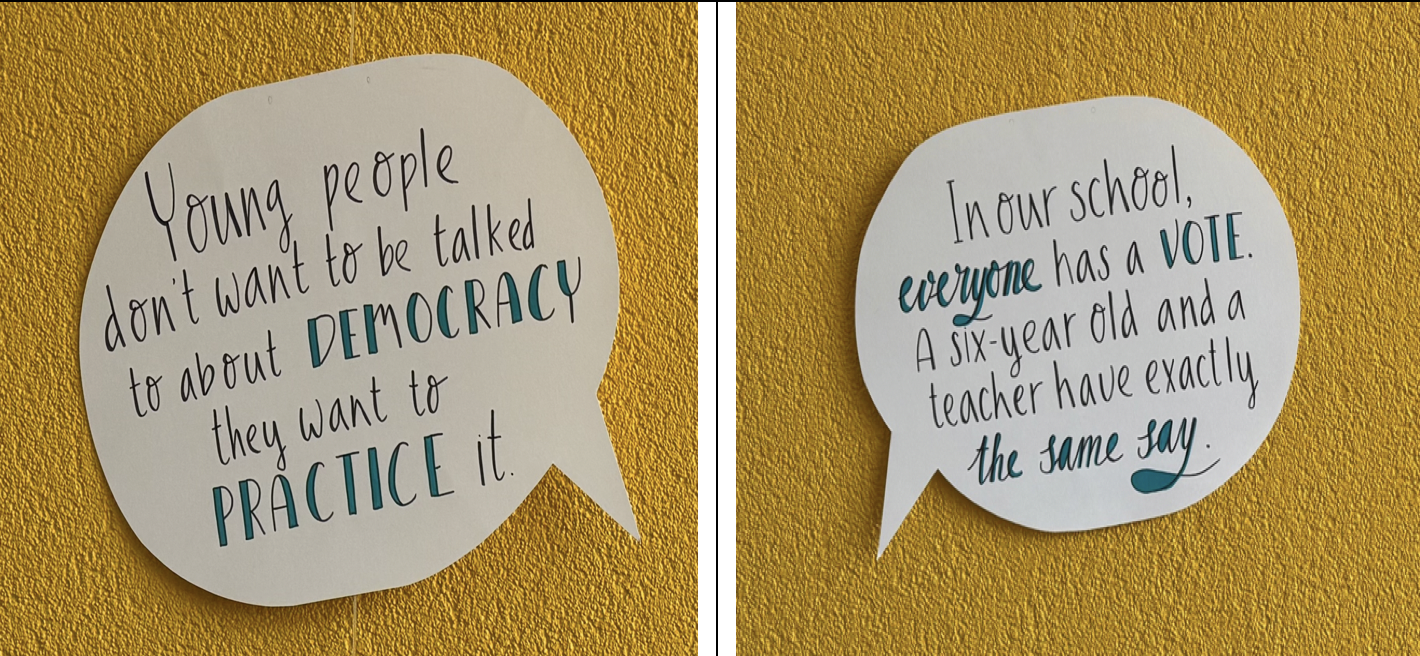
And what do the people we spoke to during this project think? We tried to reflect that in the exhibition for our event on 17 June 2026, which can be viewed here in pictures:
Warning
Co-funded by the European Union. However, the views and opinions expressed are solely those of the author(s) and do not necessarily reflect those of the European Union or the European Education and Culture Executive Agency (EACEA). Neither the European Union nor the EACEA can be held responsible for them.
***
Back to page FutureEd
The FutureEd project is a collaboration of ALLI asbl (LU), EUDEC ev (DE) and CollectiveUP (BE) and referenced under nr 2025-1-LU01-KA210-SCH-000351850.


 EN
 FR
 DE